Sunday, October 22, 2006

Four Peaks

10/22/06
This morning we slept a bit later than usual because we stayed up last night to view the Orionid Meteor Shower, it was a good viewing night, clear sky, zillions of stars and a stiff neck afterward from gazing skyward.
Anyway, we decided we'd go for a short jaunt so we headed for a short route we'd passed on a previous trip. The road was pretty good by Jeeping standards, with just a few minor washouts and a couple of undercarriage scraping boulders in the roadway. We began our ride on FR 429, an uphill climb overlooking Roosevelt Lake to the north and Four Peaks to the west, from there we took a plateau road FR 336 heading east toward the Superstition Wilderness. 
Four Peaks (elevation 7657 Feet) is an Arizona Landmark which can be seen for many miles away, located within the Four Peaks Wilderness and not accessible to motorized vehicles. It's the home of Four Peaks Amethyst Mine, a very old mine once worked by the Spaniards who explored Arizona in the 1500s. The gems found in this extremely isolated location were of such excellent quality that they were sent to Spain where they became part of the Spanish crown jewels. The mine itself is privately owned and mined only on an occasional basis because access by helicopter or hiking makes full time operations impractical.
We'll probably be heading back to FR 336, the temperatures were rising this afternoon so we decided not to do any hiking.  Through our binoculars we could see some interesting remains of what looked like an old placer gold mining location. I know we'll go back to check it out!
 
This is a view of Four Peaks taken from FR 429. It's quite an imposing sight to see soaring above the desert floor. I can't imagine mining at that altitude and on a mountainside to boot!
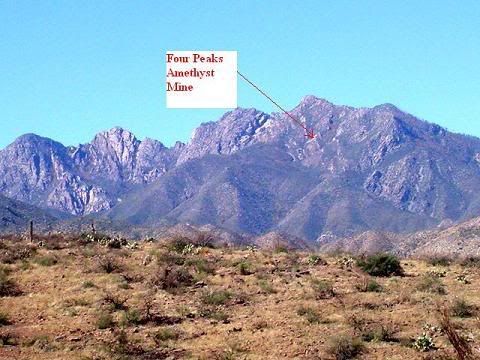
 
locatingthemine.jpg

This is an Amethyst from Four Peaks Mine

 
Amethyst2.jpg 


Saturday, October 14, 2006

Bouquet Ranch, a desert oasis

Bouquet Ranch   July 11, 2006
This is a photo taken at what used to be The Bouquet Ranch. It was named for Charles Bouquet who homesteaded the place in the late 1800's. It's located east of Tonto Creek in Arizona. (In the Tonto National Forest near Punkin Center) He didn't ranch cattle or sheep like most early ranchers did, instead, he grew fruit. Oranges, lemons, apples, peaches and pears, many of the trees he had shipped from France. Imagine keeping young trees alive on a ship and then on a trip by wagon through the desert. His original intent when he emigrated to the USA from France was to raise cattle, but he found he had a bountiful natural spring on his property, a rare commodity in these parts. Since he'd worked in his father's orchards in France, he figured he'd be better off doing something that he knew instead of trying to raise livestock.
Not much is left of the old ranch today except for a few timbers and some stones, unfortunately, it's been bulldozed. It sits on private property within the National Forest. The one thing that remains is the beautiful, shady oasis, the Bouquet spring. There are about 10 enormous palm trees Charles Bouquet planted at the water's edge with their roots in the water. They're flourishing today. It's hard to imagine such a place exists in the Arizona desert, especially on a 110 degree day like today.
When we were there, it was full of bullfrogs and water birds, taking refuge beneath the palm tree's heavy skirts. What a site!


Thursday, October 5, 2006

The Apache Trail

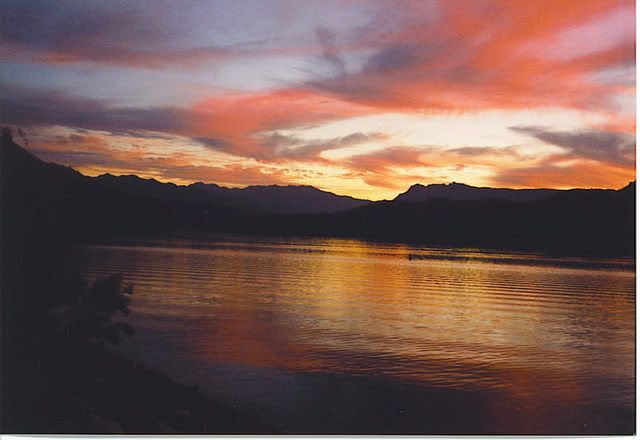
SunsetArizona.jpg


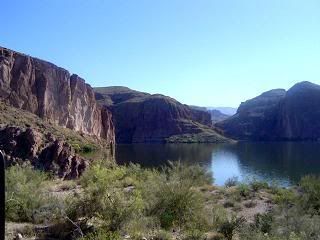
                                                               ApacheTrailEarlyMorning003.jpg


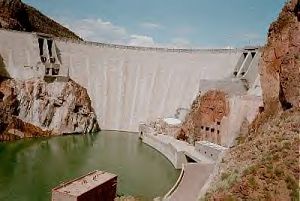
RooseveltDamShot.jpg


                                      The Apache Trail

Lore and legend cloak canyon walls with an air of mystery

Sheer cliffs of stark grandeur careen toward peacefulrivers

 Silent breezes are accented by cries from soaring hawks

We envy their freedom to view this world from a unique vantage

 Boulders balanced upon tenuous perches as though placed there by playful hands

Spires and minarets of sandstone by no accident call to mind holy places

Lakes of unfathomed depth keep secret the hidden vista below

 Each mile is given to us as a gift revealed as we venture on

Dizzying heights give way to peaceful meadows, our senses are assailed by what unfolds before us

Layers of time are seen in ageless formations

Cactus basks beneath the broiling sun luxuriating in the nourishing heat

Storm clouds sneak in unnoticed by enthralled travelers

 The sky darkens to rich gray hues, a deep growl of thunder echoes followed by unleashed streaks of lightening splitting the boiling clouds

The hawk dives for cover sensing what is to come

Monsoon rains fall fast and hard upon the arid landscape

The sand drinks 'til sated then rejects the leftovers filling once dry washes and gulches as waters stampede to lower points

 Rocks with eons old addresses move with the torrential onslaught seeking relocation

As quickly as the storm enters, it vanishes as the clouds are tossed aside by the jealous sun, eager to retake his domain

The hawk shakes and preens droplets from his feathers, then leaps joyously forth to survey the changes

Catching a current, he ascends smoothly, dipping and gliding his dance beneath the sun

Reaching a rise, we pause to survey the panoramic wonder spread before us

Our eyes try to reject the reality of such contradiction

Green, brown, blue and purple assault our senses in a riotous ballet of colors

Moving on, we see scorched ground which bespeaks a bygone day when hellish blazes charred the already arid earth

Tiny shoots of infant cacti pierce the sand refusing to concede defeat

Weary and dusty we come upon man's imposition on the land

 Rising from the depth of a canyon, steel and concrete seems alien in these surroundings, daring to ration water to the valleys below.

Exhilaration is felt as we reach trails end, yet the lore and legend beckons our return

Our spirits are lifted, our souls have been nourished

©1999-2007 Laura Aden

Special thanks to the Tonto National Forest Rangers (Roosevelt Lake)

10/5/06

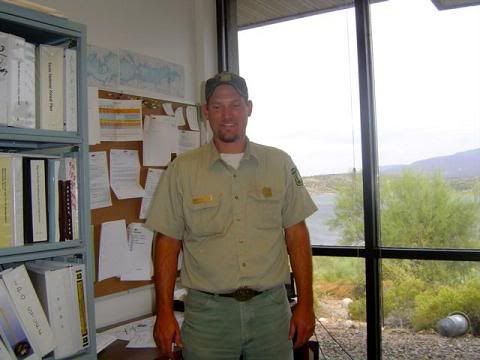
We would be remiss if we didn't take this opportunity to thank the fine people at the Tonto National Forest Ranger Station. In particular, Forest Ranger,Quinton Johnson who has answered numerous questions and told us some wonderful places to seek out. He knows the TNF like the back of his hand and is more than willing to share his knowledge.

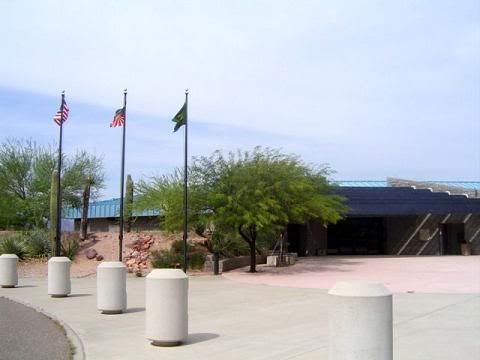
We're lucky to live just minutes away from the Roosevelt Lake Visitor Center which is also home base for our local Ranger Station.

Thanks so much!

This is Quinton Johnson, Ranger Extraordinaire!

QuintonJohnsonTNF001.jpg

Visitor Center and Ranger Station at Roosevelt Lake 
QuintonJohnsonTNF002.jpg


Desert beauty

Many people who haven't visited Arizona really have the wrong impression of what it's really like. Picturing Sahara type sand dunes, a stark environment and camels is quite different than it really is.  Of course summer temperatures are not fit for man nor beast, but that's why air conditioning was invented. The rest of the year we've got a moderate climate making Arizona a wonderful place to be. We get ample rains most years to keep the desert green and thriving with an array of fabulous desert plants. Below you'll see pictures of some of the more common ones in our area. There are quite a few more, but I'll have to post them at another time after we get some good shots.
Hope you enjoy our desert flora!
 
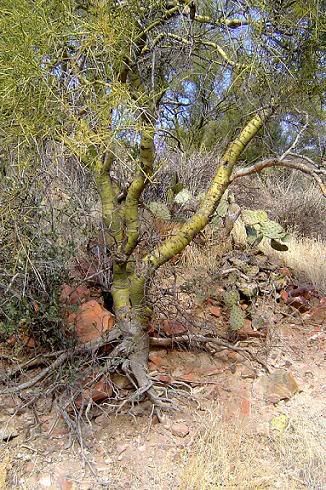
This is one of my favorites, a Palo Verde Tree (Spanish for "green stick") a lovely tree that bears pretty yellow flowers. The bark and branches are a lime green color, very nice!

PaloVerde.jpg

 
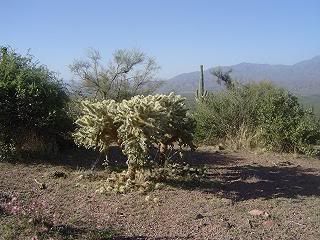
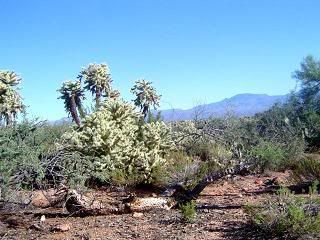
This is the Teddy Bear Cholla, it sounds soft and cuddly
It's NOT!

JumpingCholla.jpg

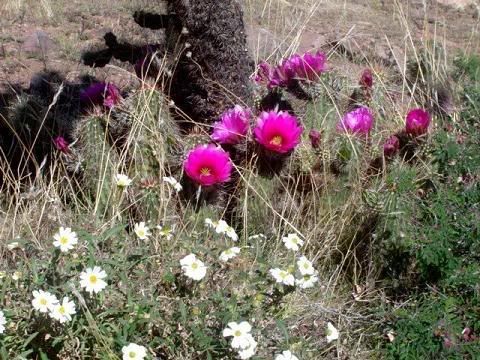
This is a Hedgehog Cactus and Daisies in bloom beneath a Cholla.
BloomingHedgehog.jpg

Jumping Cholla Cacti, this is one of the desert's bad boys. (no they don't really jump but if you pass close to one, you're almost guaranteed to get stuck!) The spines fall on the ground and if stepped on, they can puncture even a heavy hiking boot.

JumpingCholla-1.jpg

 
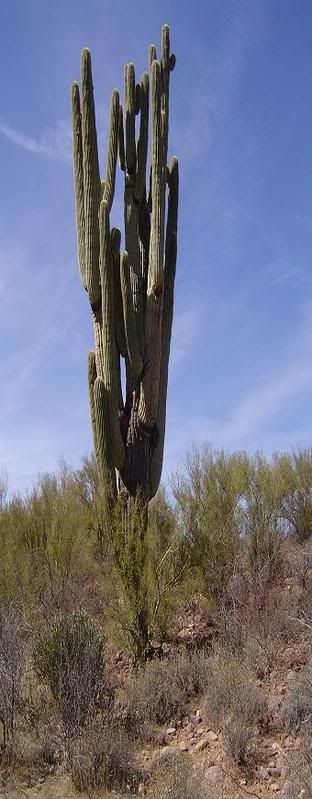
The symbol of the desert. The mighty Saguaro. These giants can live to be several hundred years old. They're masters at storing water within their pleated skins which expand as water increases. They provide shelter to a variety of desert dwelling birds and critters.

MightySaguaro.jpg


 The Ocotillo looks like a cactus but really isn't, it's got leaves and cacti don't have leaves. It blooms in the springtime bearing pretty red flowers on the ends of each stem. Early ranchers often planted these instead of using barbed wire because the spiny stems would keep cattle contained within the confines of the living corral.

Ocotillo.jpg

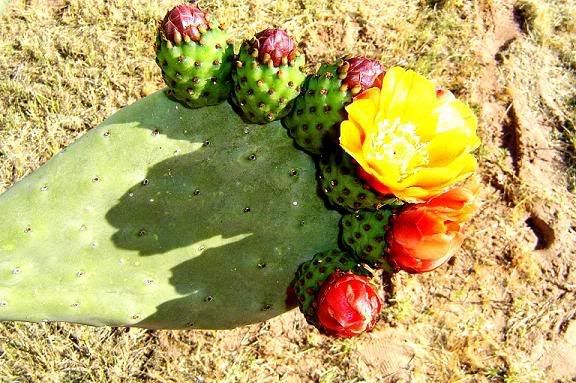
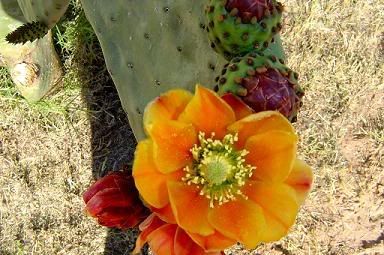
This is our giant Prickly Pear growing alongside our house. The blooms look like something right out of a Georgia O'Keeffe painting.

GiantPricklyPearYellow.jpg

The same cactus decided to put out orange flowers instead of yellow 
GiantPrickyPearBlooming.jpg

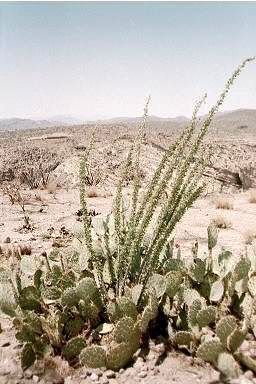
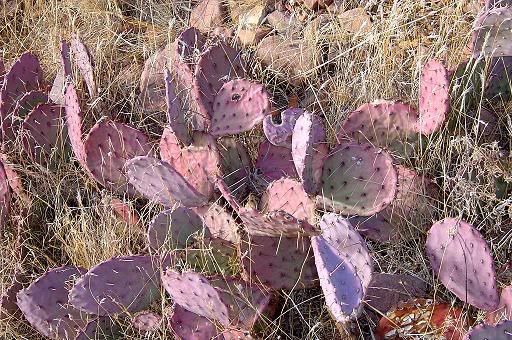
This is another variety of Prickly Pear growing wild. In the colder months they turn from green to purple.  Javelina (the southwest version of a wild pig) love the Prickly Pears, they eat them spines and all...ouch!
ACrossRoad013.jpg


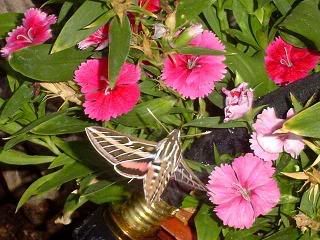
A Hummingbird Moth who came to visit our window box

HummingbirdMoth003.jpg  


Wednesday, October 4, 2006

Reavis Ranch, Campaign Trailhead

9/18/06
We packed up a couple of ham sandwiches and cold drinks and headed out at first light for parts unknown. We're going back over trails nearest our home because the first time we ran them, we were still unfamiliar with the Jeep and really not paying close attention to our surroundings.
We wound up on FR 449 Campaign Trail, heading for the Reavis Ranch Trailhead. Reavis Ranch was once the home of Elisha Reavis, (born 1827 died 1898) also known as "The Hermit of the Superstitions."
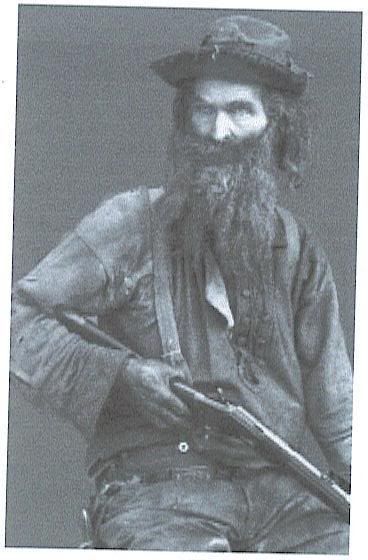
He was an interesting character to say the least. He was a well educated man and at one time he taught school in California and married. He gave it all up to pursue the lust for gold that was the fashion of the time in the desert southwest. People still speculate as to whether ever found the gold at the end of his rainbow. When his estate was probated in Phoenix, no gold was reported, but it was very much the style of that period to bury found gold in secret locations. After wandering the hills and deserts, he finally settled in the Superstition Mountains and homesteaded a ranch high up in the mountains where he grew apples and other fruit. His body was found alongside the trail near his orchards. He was buried where he was found, alongside his beloved long time companion, his mule. To this day it is said that he and his mule, can be seen still walking the canyons near his ranch. The beautiful, mysterious, Superstition Wilderness abounds with such ghostly tales.
 
Elisha Reavis 1827-1898
"The Hermit of The Superstitions"

x95tmp.jpg

 
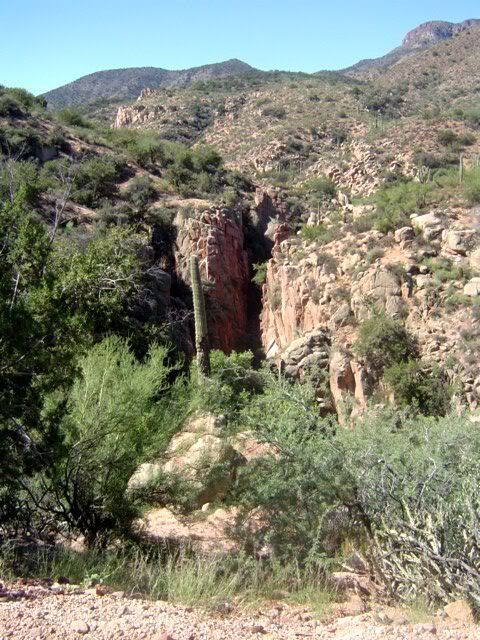
Haunted Chasm, The ghosts of Elisha Reavis and his mule are said to wander these canyons and mountains....searching.....
HauntedReavisChasm.jpg

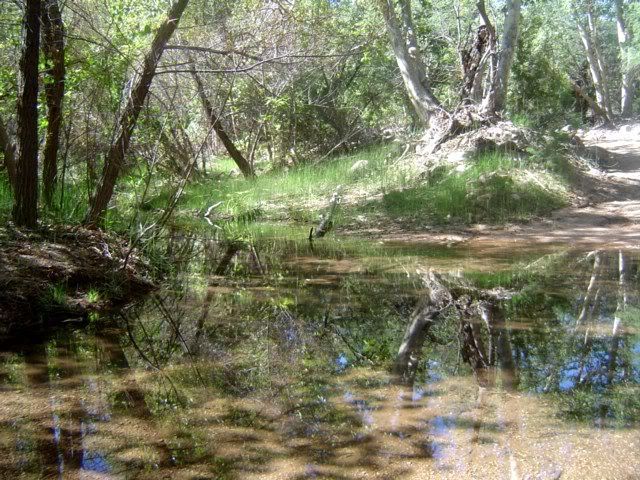
The Crossing at Campaign Creek 
CampaignCreekCrossing.jpg


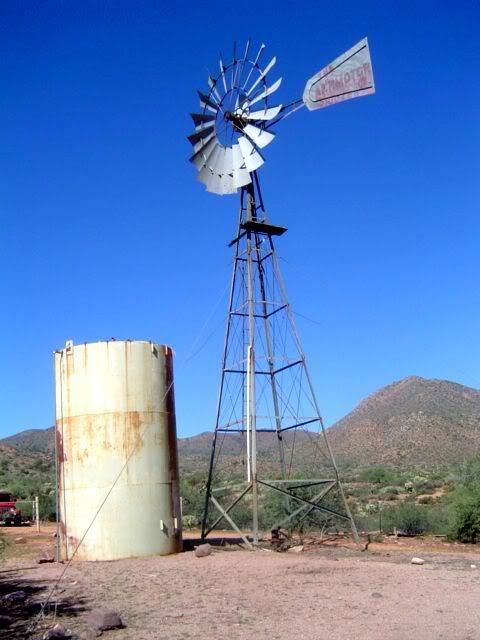
It's not an unusal sight to see windmills and water tanks in the back country. They pump water for free range cattle from cool underground springs.  


RidetoCampaignTrailheadReevis009.jpg

 
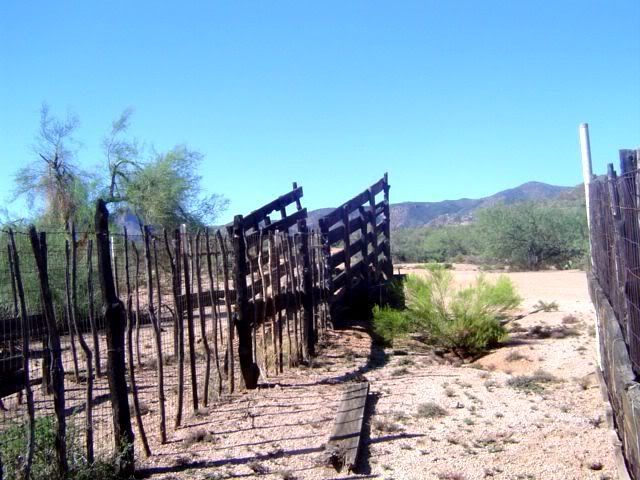
This is one of the many corrals found scattered around the back country.
 
RidetoCampaignTrailheadReevis011.jpg

 Here's a small herd of free range cattle. They have the right of way on all backroads!

MoocowsA-cross001.jpg


Tuesday, October 3, 2006

Our "Old Peep's Jeep"


This little treasure was a Christmas gift to each other.  It has entirely changed our retirement. When we decided it was time to spend more time together and eliminate the job stresses we moved from California to our "fixer-upper" in beautiful Roosevelt, Arizona. We thought we'd probably spend a lot of our time fixing up our home, reading and doing the kinds of things we imagined retirees were supposed to do....WRONG! After getting our humble abode in livable, cozy condition, we found we were looking for more fulfillment to stimulate our all- too-quickly-aging brains, so we went looking for a pickup truck that would both fill the need to haul junk around and also take us places that our little Toyota couldn't.

Well, we saw our little red Jeep sitting on a hillside at a dealership lot ... it was love at first sight.  The rest as they say, is history. Although it's not much in the way of hauling large stuff around, it hauls us just fine. We christened it "Old Peep's Jeep". We're now able to go places we never dreamed of going before and certainly places that most folks don't ever get to see in an "ordinary" vehicle. Now, we spend almost every day during the cooler months (September to June if the temperatures hold) exploring abandoned mining sites, ghost towns or just experiencing all that Arizona has to offer in the way of scenic beauty.

When the temperatures begin to climb to the upper 90s and 100s, we throw out the anchor and spend time indoors, researching online the places we've discovered and reading every available book we can find on these fantastic pieces of Arizona's history.  Life is good, the rocking chairs will have to wait, we're not ready for them yet!

                                                     Name:  rockingchair2.gif
Views: 12
Size:  5.2 KB    Name:  rockingchair2.gif
Views: 12
Size:  5.2 KB